


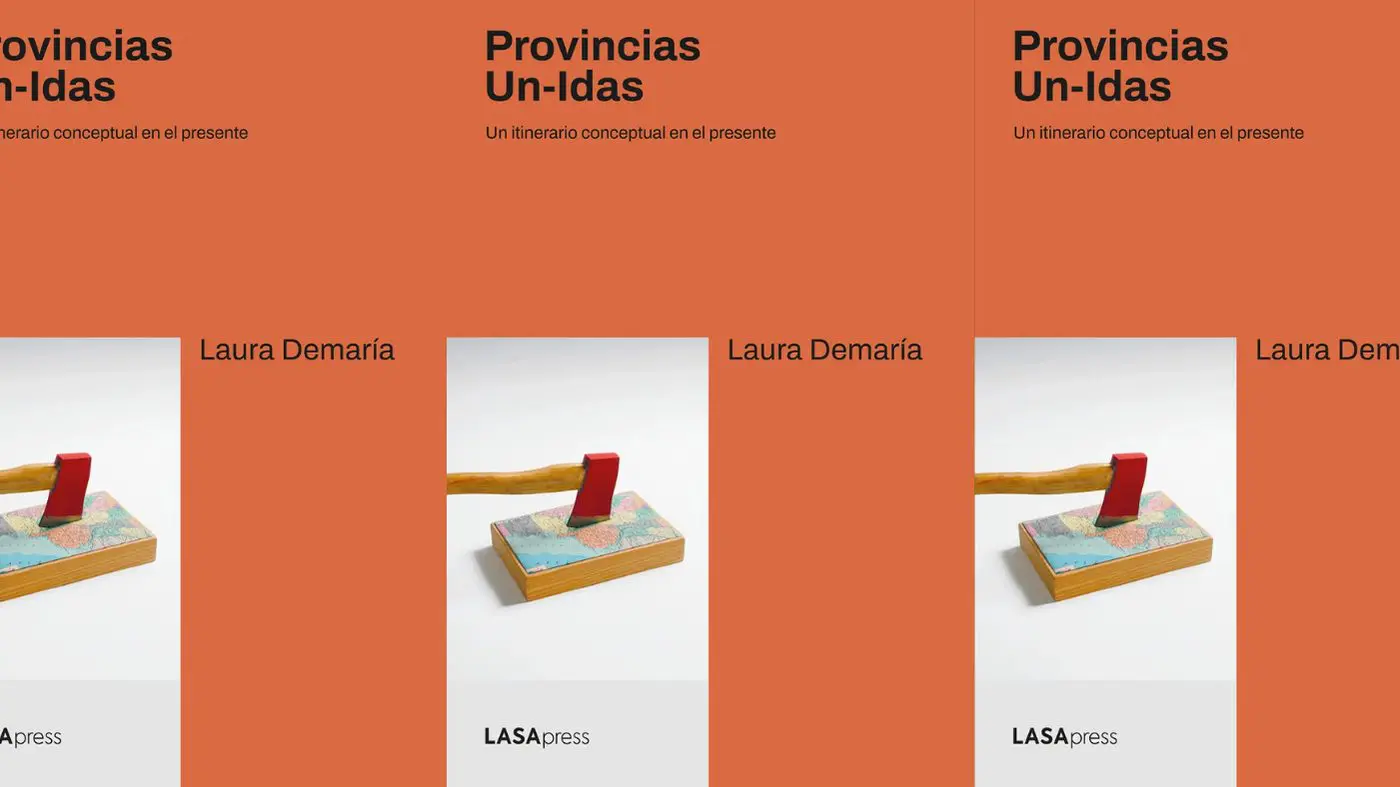

The Writer’s Center welcomes the Graduate students from the Department of Spanish and Portuguese at the University of Maryland to a dialogue with Professor Laura Demaría about her recent book, Provincias- Un-Idas: Un itinerario conceptual en el presente (LASA Press, 2025). In the book, the concept of the province unfolds as a theoretical category that reorders ways of thinking about the here and now. For this conversation, we suggest reading the chapters “On the Province Today” and “Part I. A Conceptual Itinerary.”
We encourage you to order a copy of the book from your local, independent bookseller or directly from the publisher
FREE & open to the public. RSVP below.

Laura Demaría es profesora de Literaturas y Culturas Latinoamericanas en el Departamento de Español y Portugués de la Universidad de Maryland, College Park. Recibió su licenciatura de la Universidad Nacional de Córdoba, Argentina, y su Ph.D. de la Universidad de Washington en St. Louis. Es autora de Provincias Un-Idas: Un itinerario conceptual en el presente (LASA Press, 2025), Buenos Aires y las provincias: relatos para desarmar (Beatriz Viterbo Editora, 2014) y Argentina-s: Ricardo Piglia dialoga con la generación del 37 en la discontinuidad (Editorial Corregidor, 1999). También es escritora creativa y ha publicado Prosa chica (Borde Perdido editora, 2020), St. Louis Blues (Rialta Editora, 2018) y Cruces de Carlota (Alción, 2008), una colección de cuentos. Su libro Buenos Aires y las provincias fue galardonado con el Premio de Humanidades 2015 de la Sección de Estudios del Cono Sur, perteneciente a la Asociación de Estudios Latinoamericanos (LASA); Cruces de Carlota recibió el Premio de Literatura Latinoamericana de la Universidad de California en Los Ángeles. Actualmente trabaja en su segunda novela, Laiseca.
Laura Demaría is Professor of Latin American Literatures and Cultures in the Department of Spanish and Portuguese at the University of Maryland, College Park. She received her undergraduate degree at the Universidad Nacional de Córdoba, Argentina, and her Ph.D. at Washington University, in St. Louis. She is the author of Provincias Un-Idas: Un itinerario conceptual en el presente (LASA Press, 2025), Buenos Aires y las provincias: relatos para desarmar (Beatriz Viterbo Editora, 2014), and Argentina-s: Ricardo Piglia dialoga con la generación del 37 en la discontinuidad (Editorial Corregidor, 1999). She is also a creative writer and has published Prosa chica (Borde Perdido editora, 2020), St. Louis Blues (Rialta Editora, 2018), and Cruces de Carlota (Alción, 2008), a collection of short stories. Her book Buenos Aires y las provincias was awarded the 2015 Premio Humanidades by the Section Studies on the Southern Cone, affiliated to the Latin American Studies Association (LASA); Cruces de Carlota received the University of California-Los Angeles Premio de Literatura Latinoamericana. Currently she is working on her second novel, Laiseca.
About the Book
“Esa cosa que las filosofías de la historia argentina llaman ‘El Interior’, y que ellas se representan como una especie de ente global amorfo, oscuro, opuesto al otro ente claro, formal y específico –Buenos Aires–, en cierta consabida dialéctica de la existencia nacional”. Si se cambiara “interior” por “provincia”, la frase de Bernardo Canal Feijóo en De la estructura mediterránea argentina (1948) podría perfectamente servir de epígrafe a este libro de Laura Demaría. De hecho, ella misma dedicó un capítulo iluminador a Canal en su libro anterior, Buenos Aires y las provincias (2014). Pero si en ese libro se ocupaba de desarmar esa “consabida dialéctica”, la propuesta de Provincias Un-idas es centrarse ahora en el polo de “lo provinciano” para desmontarlo y reconfigurarlo en los mil planos de creación artística e intelectual que presentan una nueva geografía de la cultura, no sólo para Argentina, sino con incursiones decisivas por Chile y Colombia.
Edward Shils mostró hace tiempo la lógica implacable con que la dinámica metrópoli-provincia diseña el mapa intelectual. Desde la provincia, esa dinámica suele ser respondida con dos actitudes: abroquelarse en la lealtad localista a una tradición, o ejercer la ventaja periférica de apropiarse de todas las tradiciones (la conocida jugada de Borges, que demuestra de paso que, con el mapa en otra escala, Buenos Aires también es una provincia). Apoyándose en ejemplos contemporáneos del arte y la literatura que dan por superado todo estereotipo regionalista, Laura Demaría propone una respuesta diferente y original: un programa teórico de desestructuración general del lugar asignado a la provincia, reemplazado en plural por “lugares asimétricos, heterogéneos, múltiples”, al punto de incluir tipográficamente el quiebre en el guión del título. Se puede pensar que aquella dinámica implacable no se desvanece por un acto de voluntad teórica, pero eso sólo califica el desafío, que este libro encara con una confianza contagiosa.
“That thing that Argentine historical philosophies call ‘El Interior’ (the interior), which they represent as a kind of amorphous, obscure global entity, opposed to the other clear, formal, and specific entity—Buenos Aires—in a certain well-known dialectic of national existence.” If “interior” were replaced with “province,” Bernardo Canal Feijóo’s phrase in De la estructura mediterránea argentina (1948) could perfectly serve as an epigraph for this book by Laura Demaría. In fact, she herself dedicated an illuminating chapter to Canal in her previous book, Buenos Aires y las provincias (2014). But while that book sought to dismantle that “well-known dialectic,” Provincias Un-idas now focuses on the pole of “the provincial” in order to deconstruct and reconfigure it in the thousand planes of artistic and intellectual creation that present a new geography of culture, not only for Argentina, but with decisive incursions into Chile and Colombia.
Edward Shils long ago demonstrated the relentless logic with which the metropolis-province dynamic shapes the intellectual map. From the province, this dynamic is usually responded to with two attitudes: retreating into local loyalty to tradition, or exercising the peripheral advantage of appropriating all traditions (the well-known move by Borges, which demonstrates in passing that, on a different scale, Buenos Aires is also a province). Drawing on contemporary examples from art and literature that transcend all regionalist stereotypes, Laura Demaría proposes a different and original response: a theoretical program of general deconstruction of the place assigned to the province, replaced in the plural by “asymmetrical, heterogeneous, multiple places,” to the point of including the break in the title’s hyphen typographically. One might think that this relentless dynamic cannot be dispelled by an act of theoretical will, but that only qualifies the challenge, which this book tackles with contagious confidence.
If you need an accommodation for this event, please contact us at access@writer.org. We will attempt to fulfill all requests, but advance notice is necessary to arrange for some accessibility services.
Enjoying our free events? Help us offer more programs to support writers with a $10 donation »