A Slow Descent Toward Hope – Interview w/ Zach Powers
04.14.2026
Follow us
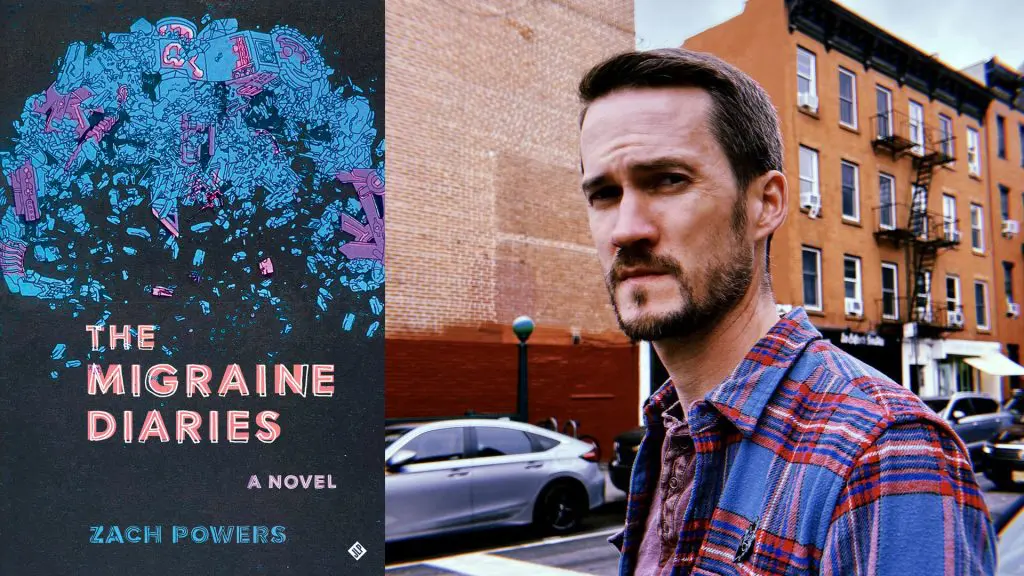
A CONVERSATION WITH TWC DIRECTOR ZACH POWERS ABOUT HIS NEW NOVEL, THE MIGRAINE DIARIES
By Amy Freeman
When I was asked to interview Zach Powers, who is not only my friend, but also my boss, my only question was, “How annoying can I make this for him?” Given free rein, I decided to ask him questions about his latest novel, The Migraine Diaries, from the perspective of the protagonist’s headaches. Here’s how that went:
Migraine: I’m a little miffed that, although I’m arguably the backbone of the novel (if a migraine can be a backbone), I’m not a proper noun. You refer to me as “the hurt,” or “the pain.” In your own words, I threaten. I keep you moored to the spot. I sleep in a corner of your head. I’m a main character, I’m never capitalized. Why not?
Zach Powers: Damn, migraine, you’re coming right out with the hard hitters. I think when it comes to illness narratives, the way we talk about the illness is intricately tied to how we experience the illness. The illness has undeniable power over a person’s life, so I think it’s important, whenever possible, to not give in to the temptation (because it is tempting!) to grant the illness even more power. Migraine, you’ve mucked up my life more times than I can count, which inspired the narrator’s experience, so I’m not willing to grant you personhood. In reality you’re not a person. You’re literally in the narrator’s head. And fight you as much as he might, you can’t be a true villain because—I think I get into this in the book as well—you’re his self hurting himself. Turning oneself into the villain would add harm on top of harm for a person with chronic illness.
I, physical pain, first appear while the protagonist grapples with the emotional pain of a close friend’s death. Would this story even exist if the protagonist didn’t have to grapple with both kinds of suffering, in tandem and in perpetuity?
I wanted to write about the experience of you, migraine, but I also worried that would be a hard sell for readers. So, I decided to tie that to an experience I know readers love the heck out of: grief. It’s a little bit of a bait-and-switch. But also, the experience of pain and the experience of grief become metaphors for each other. From a writing perspective, that’s always where I get interested. I like to discover how two elements play against each other, and how the evolution of one reveals new things about the other, which then evolves itself, and they go back and forth redefining each other and further evolving.
This book holds a lot of pain, both physical and emotional, to wit: headaches (obviously), bruising, anaphylaxis, and immense grief. Can you talk about how the physical pain I inflict on the protagonist (sorry about that, but it’s my raison d’etre) informs the emotional suffering he’s enduring?
I think one of the interesting things that emerged from the interplay of the two pains is that they interfere with each other. Instead of compounding, the physical interrupts the processing of the emotional and vice versa. In a way, this still ends up as a form of compounding, because neither pain gets properly dealt with. Also, grief is inherent to chronic illness. In the novel, it’s manifested in a separate cause of grief, a friend’s death, but in real life, to become sick is to lose some part of oneself. That’s a sort of partial death. That’s grievable. I’m not a mind-body dualist, so to me that means the emotional has a physical component and the physical an emotional component. To hurt is to grieve and to grieve is to hurt.
The protagonist searches for a cure for, well, me, as he tries to heal from the loss of his friend. He’s looking for…something else. How does hope factor into this story?
One of the things I try to show in the novel is the unmaking of a life. A significant enough chronic illness can cause fundamental changes in a person. Hope, then, comes in the form of accepting, if not embracing, those changes. There’s no other side of a chronic illness. You don’t get better. The narrator doesn’t seem likely to stop having migraines. But there is another side to the unmaking (as opposed to the illness itself). So, maybe more accurately, hope comes from the process of remaking a revised version of self that accounts for the illness. Or something like that? In this way, illness narratives resist traditional story structures. I don’t want to spoil too much of the novel, but I can say that “endurance” can’t be a key moment or an event, much less a climax in the traditional sense. Maybe, then, the climax is the first migraine in the opening scene and everything after is denouement, a slow descent toward hope.
Personally, I’m not crazy about the whole “beauty is pain” trope I’ve seen bandied about. Yet, I think there’s some truth to it. I mean, you attribute moments of wonder to my appearances, like when you describe the twinkling phosphenes I show you. (A phosphene is the phenomenon of seeing light without light actually entering the eye. I looked up the term.) Sometimes, the phosphenes form constellations, like the close friendship structures altered by KJ’s death. What’s your take on whether there is beauty in pain? And how does that affect the protagonist?
One of the instigating questions when writing this novel was whether or not it was possible to make art from this particular negative experience. The catch is that I don’t think there’s any beauty inherent to the experience. At the same time, I’d say there’s no beauty inherent to a clear blue sky or cherry blossoms. Beauty comes from the interaction of a human mind with a subject. So, it’s possible to take a crappy subject, like debilitating pain, and explore it, after the fact, in a way that leads to poetry or insight or meaning. I was interested in that poetical potential. I was interested in what my mind might discover if I dwelled in a place I would usually not want to dwell.
If you pen a sequel, can I have my own narrative arc?
Sorry, pal, no sequel this time. Anyways, a narrative arc implies chronology, and the first thing to go during a migraine is a sense of time. Instead of an arc, the novel’s structure is an infinity symbol. Migraine—like grief—is timeless and endless at once.
I’m GreedyBy Joyce Siegel – Rockville, MD1st Place While looking out the window of my condo one day I saw a woman who appeared to be 30”ish” walking by. She […]
The Weight on the BenchBy Nolan Chen – Poolesville High School1st Place I sit on the black bench, my hands gently poised above the field of monochromatic keys. Golden rays […]
Weeding Fish MintBy Thu Nguyen – Gaithersburg, MD1st Place I call you by all your names: Chinese lizard tail, fish leaf, heart leaf, chameleon of my yard.The man with Roman […]
Who Said?By Eve Browne – Thomas S. Wootton High School Who says there has to be sadness?Who said I couldn’t just touch my fingers to the earth And let my […]
A CONVERSATION WITH TWC DIRECTOR ZACH POWERS ABOUT HIS NEW NOVEL, THE MIGRAINE DIARIES By Amy Freeman When I was asked to interview Zach Powers, who is not only my […]
High School Essay Contest – 1st Place The Painting in the MirrorBy Logan Moran – Bethesda-Chevy Chase High School As I step into the powder room adjacent to my attic […]
Adult Poetry Contest – 1st Place North of the AccentsBy John Whelan – Columbia, Maryland North of the eastern Canadian Providences, the Celtic lilt dissipates, disappearing into the big empty. […]
MundanityBy Leah Bulson – Richard Montgomery High School Do you mind if I set these here? whispering dogs with their heads hanging out of car windows hugs at the airport […]
High School Short Story Contest – 1st Place Beneath the Frozen MoonBy Max Bakelar – Georgetown Preparatory School His gaze flicked toward the boy. “You think you’re too good for […]
Adult Short Story Contest – 1st Place RubinaBy Asma Dilawari – Bethesda, Maryland The kettle whistled and she poured the boiling water over tea in the saucepan, recalling one of […]
Adult Essay Contest – 1st Place Golden GiftsBy Sarah Craven – Cabin John, Maryland Golden apples falling at your feet. This was a phrase my father often used to remind […]
Michele Evans on her debut collection, purl By Emily Holland Michele Evans’s debut poetry collection, purl, readers are taken on a journey through voice and time. purl brings forth new […]
A Writer’s Journey By Miriam Chernick If not for the attack on the World Trade Center on September 11, 2001, I probably would not have become a writer. When the […]
Ms. Angelou’s Sweet Song Smells of HoneyBy Lauren Ajebon – Winston Churchill High School I’m so sorry white America.My bootstraps have been cut off,the seams ripped from the back of […]
Adult Poetry Contest – 1st Place ChinatownBy May-Mei Lee – Alexandria, Virginia On 7th street,before the fire,there was a restaurant,the one with the roast pork in the windownext to the […]
High School Short Story Contest – 1st Place The Coffee ShopBy Abigail Ott Kendra checked her phone again. She had already been waiting 15 minutes for her date to show […]
High School Essay Contest – 1st Place My Two WorldsBy Hannah Brunick I stare blankly at the mirror as she smears charcoal eyeliner into a wing on my face. She […]
Adult Short Story Contest – 1st Place They Did(n’t) DanceBy Bari Lynn Hein 1. They Didn’t Dance This is Neil’s bliss: this restaurant, these people—his hardworking staff who fill the […]
Adult Essay Contest – 1st Place A Bold LipBy Raegan O’Lone Raspberry Glade. Bamboo Pink. A Different Grape. These were shades my mother pulled from her purse when I asked […]
By Zach Powers, The Writer’s Center Maryland-based writer Steve Majors recently published his gripping, startlingly honest debut memoir, High Yella, with The University of Georgia Press. He talked with us […]
New Presidents of The Washington Writers’ Publishing House, a DMV Literary Institution The Washington Writers’ Publishing House (WWPH) is a forty-seven-year-old cooperative, nonprofit, small press based in DC with a […]
By David Goodrich Originally published in the Winter/Spring issue of The Writer’s Center Magazine My friends know that I ride my bicycle quite a bit. Some years back, I started […]
By Amy Freeman Nyani Nkrumah was born in Boston and raised in Ghana and Zimbabwe. She developed her love of reading and writing from her mother, who taught English Literature […]
By Virginia Hartman As I’ve been doing readings and Q & A sessions about my new novel, The Marsh Queen, one set of questions seems to recur: How did you […]
By Amy Freeman Anthony Award-nominated E.A. Aymar’s most recent thriller, They’re Gone, was published in 2020 to rave reviews in Publishers Weekly, Kirkus (starred), and was named one of the […]
By Anu Altankhuyag The idea of fully committing to my dream of becoming an author was frightening, but I decided to go through with it and study Creative Writing for […]
By John Richard Saylor A dozen or so years ago, in early January, when the land in South Carolina is brown, mostly mud and dead leaves, and right around the […]
By Garinè Isassi On May 12 and 13, 2023, the Washington Writers Conference is celebrating its 10th conference — in its current form, that is! That final caveat leads us […]
By Priyanka Champaneri After graduating from college in 2005, I worked an office job full time while taking graduate creative writing courses at night. I didn’t quite know what I […]
VARYING METAPHORICAL DISTANCE IN PROSE By Zach Powers I moved from Savannah, Georgia, to the metro Atlanta area with my family in 1991. Because Savannah was our hometown, we drove […]
A Conversation with Philip Dean Walker about his new story collection, Better Davis By Zach Powers ZP: Better Davis is a sequel, or a continuation of, your first book, At […]
THREE WRITERS ON THE BENEFITS OF WRITING GROUPS By Amy Freeman Writing is, of course, a solitary pursuit, which is perhaps all the more reason that writing groups are such […]
By Kathleen Wheaton It was February 2020 when Washington Writers’ Publishing House decided to put out a new fiction and poetry anthology—that is, a lifetime ago. A staff meeting at […]
NOVELIST MELISSA SCHOLES YOUNG ON THE ART OF GETTING PUBLISHED By Amy Freeman Melissa Scholes Young is the author of the novels The Hive and Flood, and editor of Grace […]
In September of 2019, authors SHANON LEE and JODI SAVAGE paired up to encourage each other through the process of writing their first book proposals. By the following year, Lee […]
THE STORY OF A DEBUT NOVEL By Priyanka Champaneri After graduating from college in 2005, I worked an office job full time while taking graduate creative writing courses at night. […]
A conversation between Justin Sanders, editor of The Horror is Us (Mason Jar Press) and dave ring, editor of Glitter + Ashes: Queer Tales of a World That Wouldn’t Die […]
A chat with the editor of Taco Bell Quarterly By Amy Freeman MM Carrigan is the Editor Grande Supreme of Taco Bell Quarterly—yep, that’s a real and prestigious literary journal. […]
A conversation with First Novel Prize winner Jasmin Darznik By Grace Mott Remember the flight, for the bird is mortal. —Forugh Farrokhzad This year we’re honored to award Jasmin Darznik […]
By Emily Holland Steven Leyva was born in New Orleans, Louisiana and raised in Houston, Texas. His poems have appeared or are forthcoming in 2 Bridges Review, Scalawag, Nashville Review, […]
By Zach Powers DC-based author Morowa Yejidé joined The Writer’s Center for a chat about her forthcoming novel, the craft of writing, and the inspiration of our city. ZP: My […]